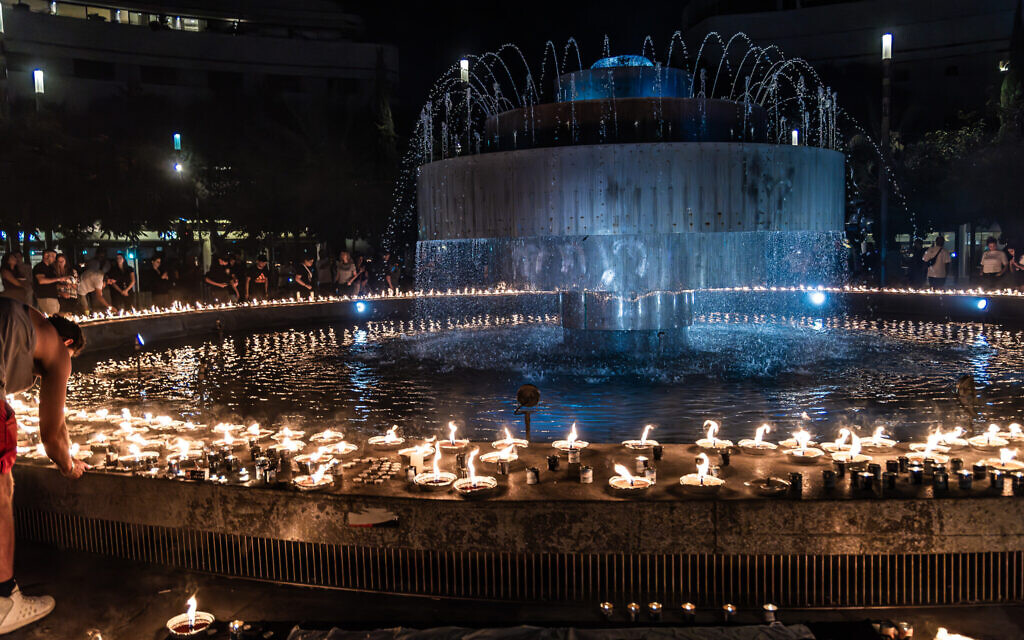


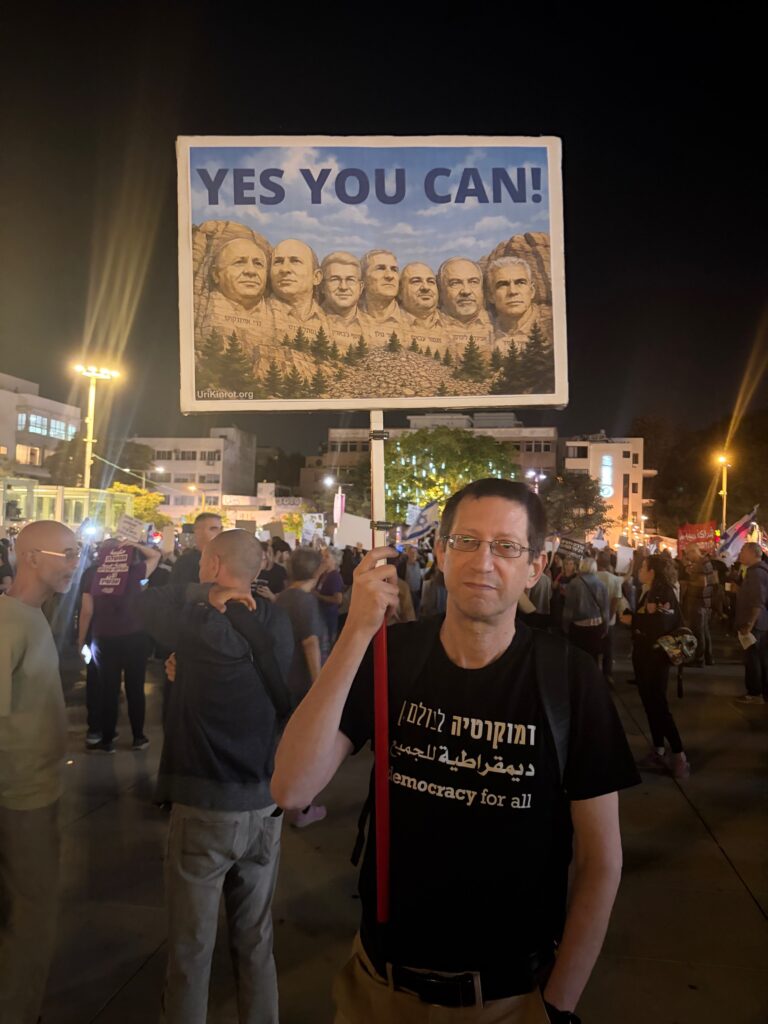
Photo taken at the demonstration in Habima Square, Tel Aviv, on Saturday, October 31, featuring the heads of the seven opposition party leaders—from left to right: Gadi Eizenkot, Naftali Bennett, Yousef Jabareen, Yair Golan, Mansour Abbas, Avigdor Liberman, and Yair Lapid.
Haham amar et dvaro. The people have spoken. This was the phrase repeated by all the commentators on Israel’s main television channels on Tuesday, October 27, at 10 p.m., as the exit poll results were being announced. Since then, the final results have been confirmed by the Electoral Commission, headed by conservative judge Noam Sohlberg, who presented them, as expected, to President Herzog on November 4: 67 seats for the anti-Netanyahu bloc and 53 for his bloc; 67 members of the Knesset, including, for the first time, those elected on the “Arab lists”, who recommended Eizenkot, a Jewish candidate, for the post of Prime Minister, whereas only 46 recommended Netanyahu, with the ultra-Orthodox United Torah Judaism party abstaining.
Anticipating such results, which suggested a high turnout among Arab voters[1], Netanyahu’s entire pre-election strategy was designed to cast doubt on their vote by seeking to discredit it. On the eve of the elections, the Prime Minister’s Office had provided the police with information about money transfers allegedly sent by Qatar to members of the Ra’am party in an attempt to influence voters. At 6 a.m. on October 27, the police, without a judicial warrant, carried out searches at the homes of three of them and arrested them. This information circulated on social media throughout the day and undoubtedly contributed to mobilising voters in Netanyahu’s bloc. All those detained were subsequently released, but the damage had been done. The aim was to sow doubts in the public mind, and those doubts remain, despite the fact that investigations conducted by the Shin Bet, under the direction of its chief, David Zini, appointed by Netanyahu a few months ago, uncovered no evidence of electoral fraud.
Netanyahu proceeded as he usually does. The truth is of little importance; the objective is to use the media to sow doubts about institutions and the way they operate. The situation became so serious that Judge Sohlberg considered it necessary to announce the results in the presence of David Zini and the government’s Attorney General, Gali Baharav-Miara. Although Zini endorsed the validity of the results, he nevertheless asked the Shin Bet to continue its investigations, using all the technological resources at its disposal. To this day, no new evidence has emerged, and many voices, including those of former senior Shin Bet officials, have criticised Zini’s irresponsible conduct in making accusations against individuals without any supporting evidence.
Netanyahu’s entire strategy is to discredit the members of Knesset elected on the “Arab lists” by accusing them of collusion with Hamas. His aim is to make it difficult for the leaders and members of the opposition’s Zionist parties, some of whom are hostile to any participation by Arab parties, to form a government with their support. If Eizenkot fails, Netanyahu hopes to force another election, which he believes might this time produce a more favourable outcome for him.
With 67 seats, Netanyahu’s opposition bloc has a numerical majority. However, because its leaders, with the exception of Yair Golan and the Democrats, pledged before the elections not to form alliances with the “Arab lists”, even through external support, it will be politically difficult for them to form a coalition unless they go back on their promises. Several options are available:
- A minority government with 48 members of Knesset. This would not be the first time the country has been governed in this way. Yitzhak Rabin did so in 1992 and was able to sign the Oslo Accords with external support from the “Arab lists” and the Shas party, which subsequently joined his government. An Eizenkot government would depend on external support from the 19 elected members of the United List and Ra’am, who would provide it with a parliamentary safety net.
- A government joined by the ultra-Orthodox United Torah Judaism party, which would bring its seven members of Knesset into the coalition in exchange for an agreement on the issue of conscripting young ultra-Orthodox men into the army. Liberman, who based his entire election campaign on opposing exemptions for the ultra-Orthodox, has made statements in recent days suggesting that he would not rule out such a scenario. Yet a recent poll among his voters showed that 59% preferred an alliance with the “Arab lists”, compared with only 41% who favoured an alliance with United Torah Judaism.[2]
- A government including the Ra’am party, whose leader, Mansour Abbas, has stated that the four conditions laid down by Eizenkot for joining his government[3] would pose no problem for him, with external support from the United List (HaReshima HaMeshutefet).
The opposition parties know that they are unlikely to achieve a better result in another election. Netanyahu’s bloc would avoid losing votes by maintaining electoral lists that failed to cross the electoral threshold this time around,[4] while the expatriates who travelled to Israel in large numbers,[5] paying their own way, are unlikely to do so again on the same scale. The opposition parties therefore have no choice but to succeed.
There is also an urgent need to replace Netanyahu. Although he no longer commands a majority in the Knesset, he still retains all his powers, including, in particular, the power to attack Iran, as he nearly did on the eve of the elections, had it not been for the opposition of Chief of Staff Eyal Zamir and the Americans. Aware of these risks and of Netanyahu’s unpopularity in the United States, people close to Eizenkot have received encouragement from Trump’s inner circle to form a government as quickly as possible.[6] Liberman, however, prefers to use the entire period allocated to Eizenkot[7] to continue negotiations aimed at broadening a future coalition by bringing in one of the ultra-Orthodox parties. He opposes any government that relies, even externally, on support from the “Arab lists”.
Alongside their ongoing negotiations, the parties belonging to the change bloc have agreed to nominate Matan Kahana, an elected member of Knesset from Eizenkot’s Yashar party, as their candidate for Speaker of the Knesset. A former member of Gantz’s National Unity party, as well as a former military officer and fighter pilot, Kahana is well acquainted with how the Knesset operates.
The Speaker of the Knesset wields considerable power, particularly the authority to appoint the chairs of parliamentary committees and set the agenda for plenary sessions, as well as the timetable for debates and votes. The Speaker also heads the Knesset’s administrative bureau, which plays a decisive role in the conduct of legislative proceedings. In the current circumstances, this authority is particularly important. The election is expected to take place on November 17.
The change bloc then intends to introduce a number of bills that it has pledged to pass, including:
- Establishing a national commission of inquiry to determine responsibility for the October 7 massacres.
- Limiting the Prime Minister to two terms in office.
- Repealing all the judicial overhaul laws passed during the previous Knesset.
They will not be able to implement this entire programme because, according to the Knesset’s legal adviser, only legislation of an urgent nature can be passed during this transitional period.
The coming weeks will be crucial for Israeli democracy. A majority of citizens voted for change and to remove Netanyahu and his allies from power. Will the leaders of the change bloc live up to the public’s expectations?
If a change government succeeds in being formed, it will represent an opportunity for the country, because, for the first time, it will have to confront two of the problems that have been undermining Israeli democracy for years:
- The integration of Arab citizens of Israel into the governance of the country. This would contradict the accusations of apartheid state repeatedly levelled by pro-Palestinian groups abroad. The strong mobilisation of Arab voters this year was certainly a reaction to the policies pursued by Ben Gvir as Minister of National Security, which allowed crime in the Arab sector to flourish with impunity until it reached intolerable levels for the population. But it also reflects their determination to take part in governing the country, and not merely at the local level.
- Finding a compromise with the ultra-Orthodox, requiring them to shoulder their share of the responsibilities involved in running the country, which currently fall exclusively on the secular population.
If this government succeeds in being formed, what initially appears to be a mixed electoral outcome could ultimately prove to be an opportunity for the country.
David Chemla
Editorial written from the article published in La Revue K
[1] Turnout in the Arab sector reached the national average, at nearly 78%, a record since turnout figures have been measured. The United List won 11 seats and Ra’am 8.
[2] Poll conducted by the aChord Centre, a research institute affiliated with the Hebrew University of Jerusalem.
[3] The four conditions are:
- Recognition of Israel as a Jewish, democratic, liberal and egalitarian state.
- A commitment to upholding the values of the Declaration of Independence.
- The imposition of a service obligation on all Israeli citizens, in the form of military, national or civilian service.
- Recognition of Hamas as a terrorist organisation and acceptance of the need to destroy its military and governing power in the Gaza Strip.
[4] 95,663 votes for Winter’s Amcha Israel list and probably more than half of the 154,950 votes cast for Haendel and Zelekha’s Reservists list.
[5] According to the American organisation Fly & Vote, which provided logistical assistance in finding airline tickets, 67,000 expatriates travelled to Israel to vote. Many others, however, made the journey independently.
[6] Al-Monitor, November 2026: “Trump officials look past Netanyahu, push Eisenkot to form government quickly.”
https://www.al-monitor.com/originals/2026/11/trump-officials-look-past-netanyahu-push-eisenkot-form-government-quickly?gift_code=9Dyi0A00bLDdkj0rMUgesBuGWk8&utm_source=chatgpt.com
[7] 28 days from the date on which he received his mandate, with the possibility of a 14-day extension granted by the President. Otherwise, Herzog may decide to entrust the mandate to another member of Knesset whom he considers capable of successfully forming a coalition. If that attempt also fails, the Knesset will be dissolved and new elections will be held.