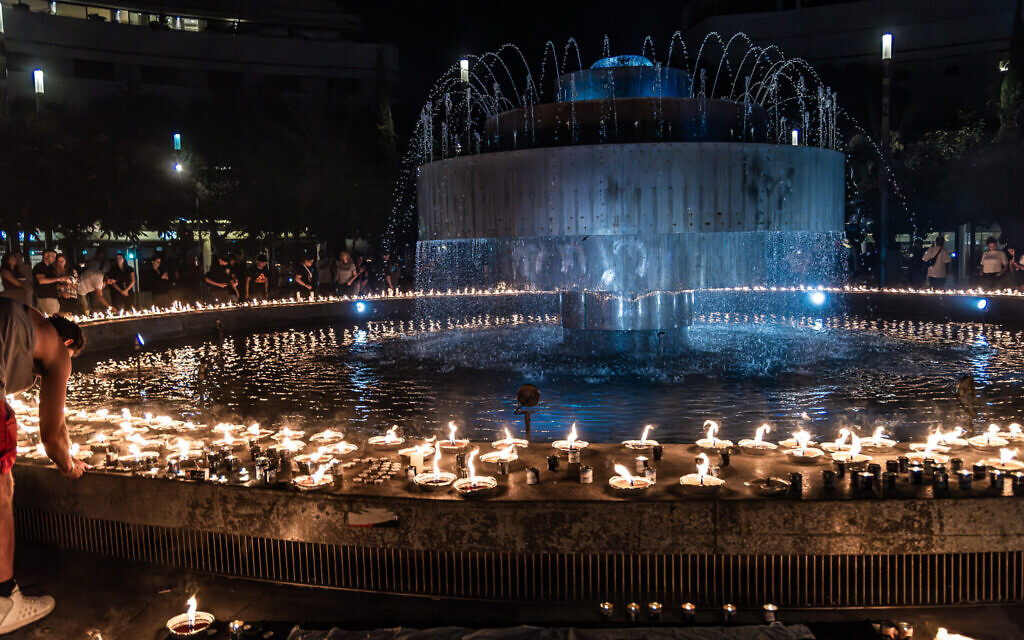


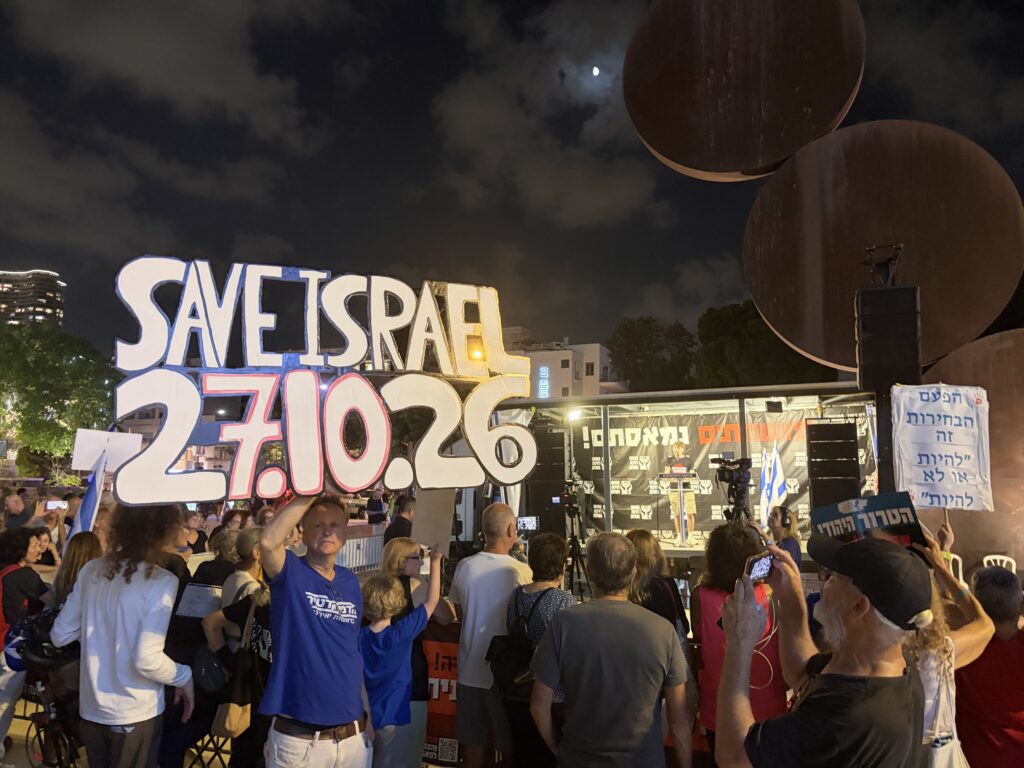
Demonstration organized by the "Movement for Quality Governance" – Habima Square, Tel Aviv, Saturday, August 22, 2026
On September 8, the lists that will stand before Israeli voters on October 27 to elect the 26th Knesset will become known. Although polls regularly predict that the outgoing coalition will not regain its majority, they do not necessarily indicate that the current opposition will be able to form one without the participation of at least one of the “Arab lists.” The vote of Israeli Arabs, who represent nearly 20% of the electorate, will be decisive. That is why we have decided to make it the subject of our next video conference, on September 14.
But beyond the electoral arithmetic, we must all understand the central issue at stake in these elections. Israeli society is facing a crucial choice that will determine its future—and also that of Jews in the Diaspora.
It can either continue evolving toward an illiberal society in which the governing majority, if re-elected, will complete the destruction of the safeguards that still protect its fragile democracy—a society in which the extremist fringe within it will pursue its messianic dream by pushing the Palestinians currently living in Gaza, and tomorrow those in the West Bank, to emigrate, even though no country in the world is prepared to receive them. This would endanger the first peace agreements signed with Arab countries.
If that were the result of the ballot, the consequences for the country would be catastrophic. Opinion polls already predict the continued emigration of young Israelis, who would join the 250,000 who have moved abroad in recent years. An increasing number of Jews in the Diaspora—especially young people—would continue distancing themselves from a country whose direction they find increasingly difficult to understand. As for the essential support for Israel’s defense, still provided by the leading Western democracies, it would continue to erode.
Israel has long since lost the sympathy it enjoyed after the massacres of October 7, because of the way the war has been conducted in Gaza and Lebanon, as well as the abuses committed by settlers against the Palestinian population in the West Bank. It will become increasingly isolated on the international stage, and its image around the world will continue to deteriorate.
Alternatively, the Israeli population—which has demonstrated over the past four years its ability to mobilize in the face of internal threats, when the government attacked its fragile institutions and the foundations on which this still-young democracy was built, as well as in response to external threats—will turn out in force on October 27 to choose to remain a liberal democracy, founded on the rule of law and open to the world; a democracy ensuring that all its citizens have the same rights and obligations, committed to ending the conflict with its neighbors and preserving the Jewish and democratic state that its founding fathers established in the Declaration of Independence.
This confrontation between two visions of the country transcends the four tribes identified by former President Rivlin as characteristic of Israeli society (Read “Israel Faces Elections Crucial to Its Future and that of the Diaspora“). It is not an opposition between secular and religious people, nor—obviously—between Mizrahim (Jews of Middle Eastern and North African origin) and Ashkenazim, nor even between the ultra-Orthodox and traditionalists, although most ultra-Orthodox Jews align themselves with the conservative camp in order to continue benefiting from the advantages granted to them by the outgoing coalition.
Rather, it is a confrontation between two perceptions of Israeli identity today, and of Israel’s place in the world and in history.
To understand the depth of the divide between these two visions, one cannot ignore the massacres of October 7 and the trauma they caused—a trauma that is far from disappearing. Israel’s Jewish population has changed over the past three years.
There are those whose choices are driven by hatred and fear of Arabs, leading to their dehumanization—something that may explain their near-indifference to the abuses committed by settlers in the West Bank. There are, of course, also those who live in a different space and time from the rest of us, whose choices are guided entirely by the conviction that they are fulfilling a messianic project, regardless of the price the country may have to pay on the international stage. One of Netanyahu’s mistakes has been to allow their representatives in government to dictate his choices in order to preserve his coalition. There are also those who, failing to recognize themselves in the country’s evolution, have moved toward genuine exile abroad or toward an inner exile. And finally, there are those who, continuing their mobilization against the judicial overhaul, then for the release of the hostages and an end to the war, are committed to defending this democracy, which is now in danger. These are the people who can be found, week after week, demonstrating against the government.
With 50 days to go before the elections, nothing has yet been decided. Although polls have regularly shown the opposition in the lead, that gap may narrow in the coming weeks.
The decision by Yoav Segalovitz, until now a Knesset member for Yesh Atid—the party led by Lapid, which is presenting a joint list with Bennett’s party in these new elections—to join the Islamist Ra’am party, led by Mansour Abbas, is a courageous choice. For the first time, it breaks down the barriers between the two communities.
Segalovitz, a former senior police officer, served in the Bennett–Lapid government as deputy minister of public security, with responsibility for the Arab sector. His work in that position led to a significant decline in crime in the Arab sector: only 116 Israeli Arabs were murdered in 2022, whereas the figure more than doubled in the following years under Itamar Ben-Gvir’s tenure as police minister. This year alone, 171 people have already been killed in clashes between criminal gangs within this community. That is why Segalovitz is now highly popular among Israeli Arabs, despite his identity as a Jewish Zionist and former senior police officer.
The opposition is preparing for every scenario, including one in which Netanyahu, seeing the polls, attempts to prevent or disrupt the elections by provoking violent incidents at polling stations on October 27, or by making it difficult for Israelis living abroad who wish to return and vote. Moreover the unspoken objective of acts of Jewish terrorism in the West Bank is to push Palestinians into resuming violent actions and inflaming the territories—something that could potentially lead to the postponement of the elections.
The campaign is now being fought largely on social media, where personal attacks against opposition leaders are common. In recent months, some of the public figures targeted have decided to respond through legal action by personally suing their attackers for defamation. An organization bringing together 150 volunteers, including many lawyers, was created for this purpose. As a result of this work, there has since been a 40% decline in the use of the terms “Nazi” and “traitor” on social media.
In conclusion, the next 50 days will have to be watched like milk on a stove, as the country prepares to enter the Jewish holiday season next week.
We will closely follow the events to come and analyze them during our next meetings. In the meantime, I would like to extend my best wishes to you and your loved ones for the New Year.
Together, let us hope that 5787 will finally be the year of change—the year that restores hope for a different future for all the peoples of the region.
Shana Tova!
David Chemla