

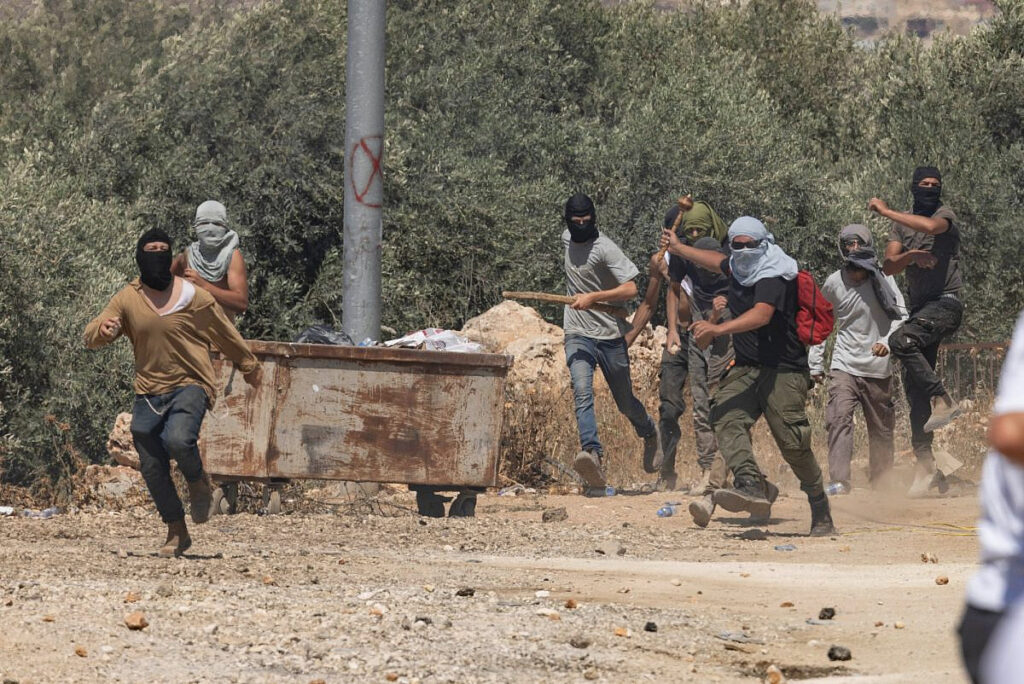
Israeli settlers attack the West Bank village of Turmus Ayya on June 26, 2025.(© Oren Ziv/B’Tselem/ActiveStills)
On March 14, a Palestinian family lost their lives in the West Bank when their car was riddled with bullets by Israeli soldiers who claimed they felt threatened. A couple and their two children succumbed to their injuries, while two other children survived them.
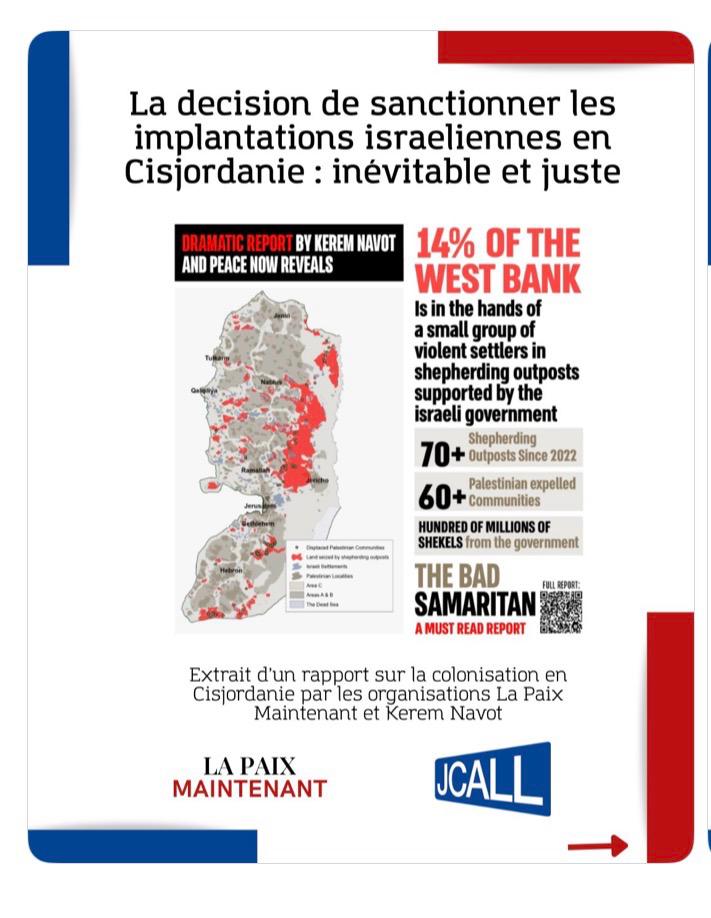
This apparent military blunder, currently under investigation, is all the more painful as it occurs amid a continuous deterioration in the living conditions of Palestinians in the West Bank, who are subjected to incessant attacks and punitive raids regularly targeting them. Since the beginning of the year, 25 Palestinians have been killed there, including 8 by settlers, and hundreds have been intimidated or expelled. Since October 7, 2023, and the Hamas terrorist massacre, nearly 1,000 Palestinian civilians have been killed, either by violent settlers or by the army.
Faced with the multiplication of incidents involving settlers, Netanyahu described them in an interview with Fox News as “a group of kids,” essentially a few bad apples. But the reality is more troubling for the State of Israel: the army is very often passive during these abuses, or even complicit, and this violence has a political and symbolic significance that goes beyond mere security concerns, raising questions for Israeli society as a whole.
An openly political project
Images and videos show settlers, often young, assaulting, humiliating, and primarily targeting Palestinians, but also Israelis who come to protect them. They reveal violence that is all the more intolerable because it often takes place in the presence of the Israeli army, which rarely intervenes and does so too weakly.
Behind the cruelty of some lies a political will to drive Palestinians away by making their lives impossible. In this sense, they are not “bad apples,” but rather the armed wing of the far right of Smotrich and Ben Gvir, who sit in Netanyahu’s government. Contrary to Netanyahu’s claims, this far right is not marginal within the government, particularly regarding the West Bank.
Smotrich is not “just” the finance minister, a prominent position that allows him to direct state budgets toward his ideological priorities and electoral clientele. He is also a minister within the Ministry of Defense, in charge of Judea and Samaria. In other words, he acts as the de facto governor of the West Bank, in a configuration that reflects the creeping annexation of Palestinian territory.
These violent settlers therefore play a major role in this annexation. They are the “raw” face of what is unfolding more quietly under this government, which seeks to make any future political solution impossible—and even boasts about it. Violent settlers and Smotrich are in fact two sides of the same vision: one political, the other enacted through violence, with the support of the Israeli government, in a society that remains largely passive toward the phenomenon, made possible—and even acceptable—by nearly 60 years of occupation of Palestinian territories.
The slow poison of occupation
As early as 1968, shortly after the victory in the Six-Day War, Professor Leibowitz—recipient of the Israel Prize in 1994 and a major (and troubling) moral voice in the country—predicted that the occupation would corrode Israel’s social fabric. It would “lead to a catastrophe for the entire Jewish people; it will undermine the social structure we have created in the State and cause the corruption of individuals, both Jewish and Arab.” It would endanger democracy in Israel, with Jews enjoying rights such as freedom of expression and movement both within Israel and in the Palestinian territories, while Palestinians would be deprived of them.
Eight years later, in 1976, then–Prime Minister Yitzhak Rabin described extremist settlers as a “cancer” that could threaten the democratic nature of the State of Israel. This echoes a speech by Yair Golan, then deputy chief of staff, in 2016, which ultimately cost him the position of chief of staff that seemed within reach. He said he observed phenomena within Israeli society that reminded him of those in Germany in the 1930s. He was not comparing the Israeli far right to the Nazis, but rather pointing to democratic erosion in societies that refuse to confront political violence and extremism, allowing them to take hold.
Fifty years after Rabin’s warning, the metastases have indeed spread to the point where his prophecy is gradually taking shape.
It must be acknowledged that these three men, from different generations, anticipated the dangers and dilemmas facing Israeli society today in its relationship to the West Bank and the consequences for its social and democratic fabric.
A gradual normalization of the unacceptable
One of the first measures taken by Israel Katz upon becoming Minister of Defense was to end administrative detention for settlers, effectively granting them impunity, while maintaining the measure for Palestinians. A shrewd politician with no experience or legitimacy in security matters, he sees this prestigious ministerial role as a way to strengthen his political base within Likud and position himself as Netanyahu’s successor.
If he adopted this measure against the advice of security officials, it was primarily out of political opportunism, which says much about the sociology and opinions of the average Likud voter. This openly discriminatory measure is precisely what Leibowitz warned against, and the lack of outraged reactions in Israeli society illustrates the concerns expressed by Rabin and Golan, forty years apart, about the erosion of democratic norms.
In fact, while the abuses in the West Bank are not supported by a majority of Israelis, they do not make front-page news or bring people out into the streets. For Israelis, what happens in the Palestinian territories often feels distant. The Green Line, deliberately blurred by the far right with support from part of the right, still remains psychologically real for many Israelis committed to the rule of law and democracy, who have demonstrated massively against judicial reforms.
However, this position is no longer sustainable and becomes schizophrenic as annexation proceeds quietly but methodically, and the army “covers” indefensible actions in the territories with the approval of the Israeli government.
In this sense, what is happening in the West Bank is inseparable from the protests aimed at preserving Israeli democracy and its place among liberal democracies. For tactical reasons, the issue of occupation had been set aside during protests against judicial reform, in order to unite as many Israelis as possible by avoiding divisive topics.
This tactic is now reaching its limits, as creeping annexation implicates all of Israeli society, particularly through the rule of arbitrariness and the law of the strongest at the expense of the rule of law. Settler violence and the pogrom-like drift rightly denounced by French philosopher and staunch Israel defender Alain Finkielkraut are therefore both a moral and existential issue for the very nature of the Israeli state and society.
A societal challenge
In 1996, Netanyahu’s campaign slogan, in the wake of the Oslo Accords and deadly Hamas attacks, was “a secure peace,” suggesting that security would lead to peace, in contrast to the left’s view that peace would bring security. Thirty years later, Netanyahu has replaced the concept of “peace through strength” with “strength for strength’s sake.”
When he portrays Israel as Sparta rather than Athens, or when he says he prefers Genghis Khan to Jesus (before awkwardly backtracking so as not to alarm his evangelical allies), he charts a path in which the sword is no longer a means but an end. In such a worldview, it is hardly surprising that violence manifests openly in the West Bank.
The challenge facing Israeli society is how it responds to this situation.
Israeli society is educated and democratic, and it does not support settler abuses in the territories. But will it go further—taking to the streets to demand an end to them, and showing the same determination as it has in opposing threats to democratic norms within Israel itself?
The demonstration of solidarity with Arab Israeli citizens suffering from endemic crime is encouraging. Even more significant are the clear statements by Chief of Staff Eyal Zamir against settler abuses, reflecting both the urgency of the situation and a welcome awakening. Likewise, Naftali Bennett’s condemnation of these abuses—he had previously expressed solidarity with Israeli Arab journalist Lucy Aharish, who was viciously attacked—is an excellent sign.
A broader civic response is needed to turn these early signs of awakening into real change, including a shift in political leadership. The Israeli far right must be removed from power, but this alone will not be sufficient. Having fueled divisions within Israel and with the American Jewish community, Netanyahu must leave political life as soon as possible—and not return.
Beyond individuals, what is at stake in Israel is its relationship to violence, force, and limits. Geographic limits, such as whether to maintain the Green Line. Ethical limits, including outlawing pogrom-like behavior and imposing exemplary prison sentences. Political limits, with a government that respects checks and balances and the rule of law. But these limits will matter little if the very idea of violence and force is not reconsidered—not as ends in themselves, but as means to achieve something else: a political and diplomatic horizon that rejects perpetual conflict.
Ben Gvir’s party, “Jewish Power,” is aptly named—it reflects the exaltation of force as a political vision and program. Smotrich’s party, “Religious Zionism,” represents a distortion—almost a blasphemy—of two terms upheld by humanists such as Yehuda Leib Maimon and Yosef Burg.
Israeli society cannot simply look away and speak of “bad apples.” These excesses are also the result of occupation, a culture of impunity, and an exaltation of force that must not be confused with security—a legitimate priority for Israelis, whether Jewish or Arab.
The political battle in Israel is no longer between doves and hawks. It is between those who prioritize security and those who prioritize force—a divide that mirrors the line between supporters of the rule of law and those who favor the law of the strongest. This is now the defining political and existential fault line, one that will be decided in upcoming elections and will shape the country for years, even generations, to come.
Sebastien Levi
source in French : Tenoua 25 mars 2026