

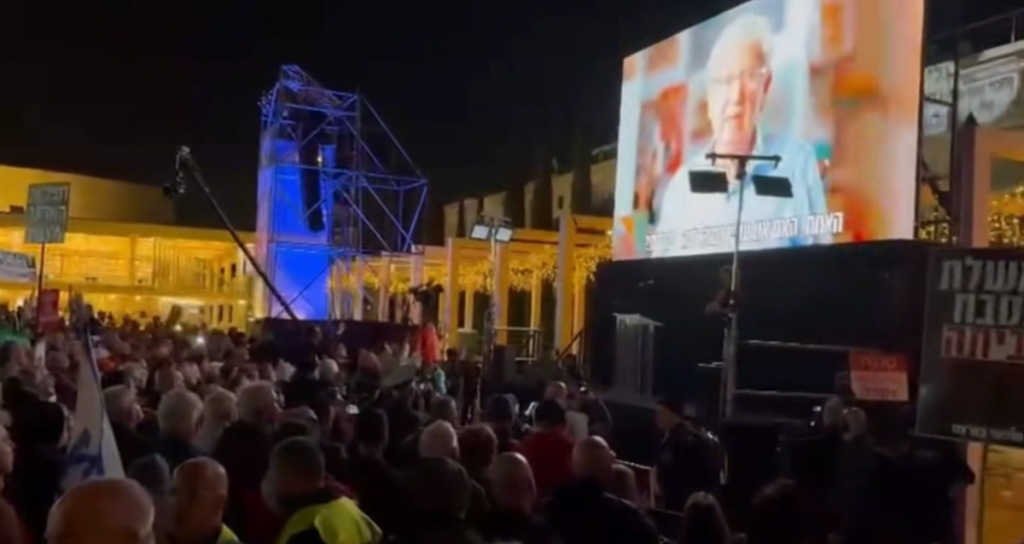
Aharon Barak, the former president of the Supreme Court, addressing protesters on January 3 in Tel Aviv
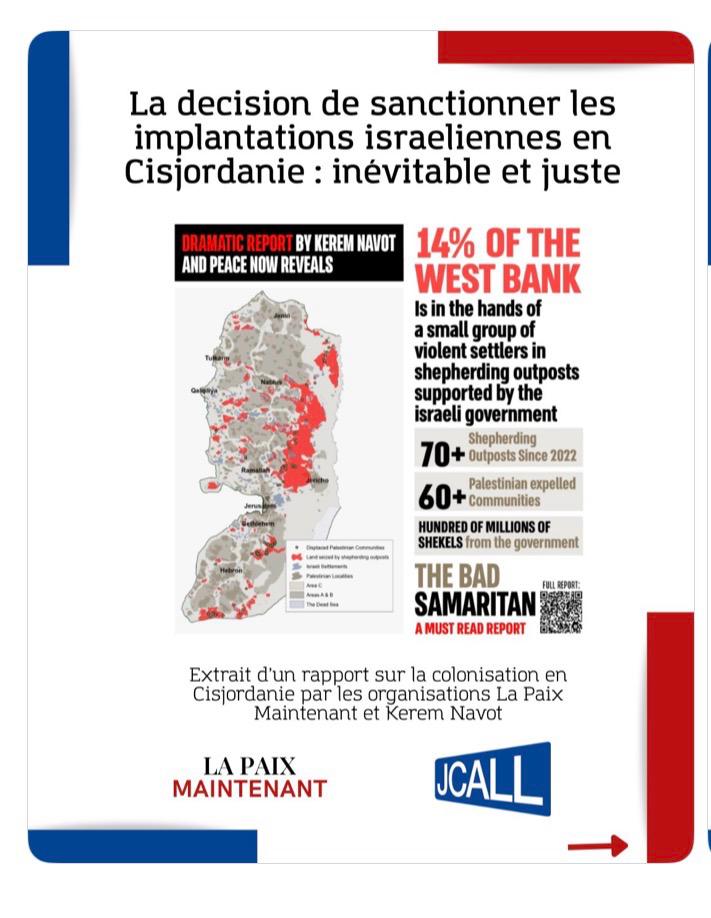
The recent ban on entry into Israel imposed on the historian Vincent Lemire—who was due to take part in a number of meetings, including with Israeli historians—a decision that was later rescinded, fits into the current context in which the government is engaged in a campaign against freedom of expression for anyone in civil society who opposes its policies. Recently, two Israelis—a man in his seventies and a literature student—were summoned for questioning by the authorities for their statements or writings on social media against Netanyahu. This campaign of intimidation also affects Jews from the diaspora who come, among other things, to take part in the olive harvest in the West Bank to help Palestinians. Indeed, this year the latter have been subjected to numerous restrictions by the army or by settlers when trying to access their olive groves. This autumn, a young American Jewish woman, a member of a Zionist movement and the daughter of a rabbi, was expelled and banned from Israel for ten years for having participated in this activity.
Despite these measures and acts of intimidation, which are intended to frighten the public and testify to the government’s hardening stance toward opposition to its policies by the majority of the population, that population has not become demobilized. I was present on Saturday, January 3, at Habima Square in Tel Aviv, where thousands of Israelis gathered to mark the third anniversary of the launch of the judicial reform. The strong public mobilization before October 7 had made it possible to prevent the Knesset from voting on the proposed laws. Then, during the two years of war that followed, this project was set aside. In recent months, the government has taken it up again, attempting to pass these laws in a parliamentary blitz. It thinks that the public—exhausted by three years of demonstrations against the judicial reform, followed by protests for the release of the hostages and demands for the establishment of a national commission to identify responsibility for the October 7 catastrophe—will no longer turn out in large numbers to demonstrate. But even if, for the time being, the streets do not see the hundreds of thousands of people who, three years ago, mobilized every week across the country, the demonstrators still show the same determination to defend democracy. The tone of the speeches delivered from the platform has even hardened.
For the first time, on January 3, the former President of the Supreme Court, Justice Aharon Barak, a jurist of worldwide renown, spoke at a demonstration against the judicial reform. He said in particular:
“Are we still a liberal democracy? My answer: not anymore! This is not a single, spectacular event. It is a process in which the very foundations of democracy are seriously threatened and democracy itself is weakening. The protection of human rights, the separation of powers, the rule of law, and the independence of the judiciary are being eroded.
Our system is now one in which political power is concentrated in the hands of a single person—the very person who controls both the government and the Knesset: the Prime Minister. For this control to be complete, the only body capable of criticizing the government—the judiciary—must also be brought under control. It is therefore not surprising that the first stage of the regime’s revolution focused on the appointment of judges and on their power to invalidate laws and government actions. When the courts are ‘ours,’ law will disappear from the state. In its place will come the power of power over the law! […]
As for the second question you are all asking yourselves—what can I do to preserve liberal democracy, my rights, the Declaration of Independence, and the state that defines us?—here is my answer.
The only factor capable of halting the deterioration of our democracy is the people. The judiciary alone will not be able to stop it in the long term. Only the people—who are at the heart of liberal democracy—can put an end to it and even allow us to regain what we were and what we hoped to continue to be.
Our democracy has always been a defensive democracy. We have the power to prevent its collapse. We can do so through active public debate, civic organization, and demonstrations—like the one you are organizing this evening. It is essential that the people protect the judiciary and its guardians. It is essential that the parties running for office commit themselves to preventing the coup and to working toward the repeal of laws and regulations that harm democracy. They must commit to protecting the judiciary, the judicial system, and its guardians.
I have devoted my entire life to public service. I am not someone who usually speaks in public squares. If I am addressing you this evening, it is because the work of our lives is in danger: liberal democracy is weakening, it is collapsing.
Each of us must proudly raise the banner of the state, and by this gesture express our loyalty to the state and not to its leaders, to the rule of law and not to the power in place.” (read the full speech)
This call was heard by some of the leaders of the protest movement, the largest since the creation of the state. Relative to the country’s population, this movement is undoubtedly one of those that has brought together the greatest number of people over time, without violence, among all those that have existed in democratic countries since the end of the Second World War.
Four of these leaders—figures who have become well known in Israel over the past three years—have decided to join the Democrats party. They declared that they had come to the conclusion that civil protest must now be transformed into political protest, not by creating a new party, but by joining the one that seemed to them the only one to represent them The Democrats. This party, created through the merger of the Avoda and Meretz parties, is currently represented in the Knesset by four members, who are among the most combative against the government’s plans through their interventions during committee work and in plenary sessions. Polls currently predict that it will win around a dozen seats.
This decision from some protest leaders undoubtedly signals the true launch of the election campaign. The elections scheduled for next November will be crucial for the future of the country, the region, and also for the Jewish people. Voters will have a fundamental choice to make that will determine the future of the country.
Either Israel will remain what its founding fathers intended and enshrined in the Declaration of Independence—a liberal democracy, “a state founded on freedom, justice and peace as envisaged by the prophets of Israel; one that will ensure complete equality of social and political rights to all its inhabitants irrespective of religion, race or sex; and that will guarantee freedom of religion, conscience, language, education and culture…”
Either it will become an illiberal democracy, increasingly closed in on itself and pursuing messianic dreams, gradually sliding toward a theocracy, or even an authoritarian government.
We will mobilize throughout this year to follow this election campaign and to support the political forces committed to bringing about a genuine change of leaders in Israel. As Professor Aharon Barak says, only the people can save democracy, in Israel as elsewhere in the world.
David Chemla