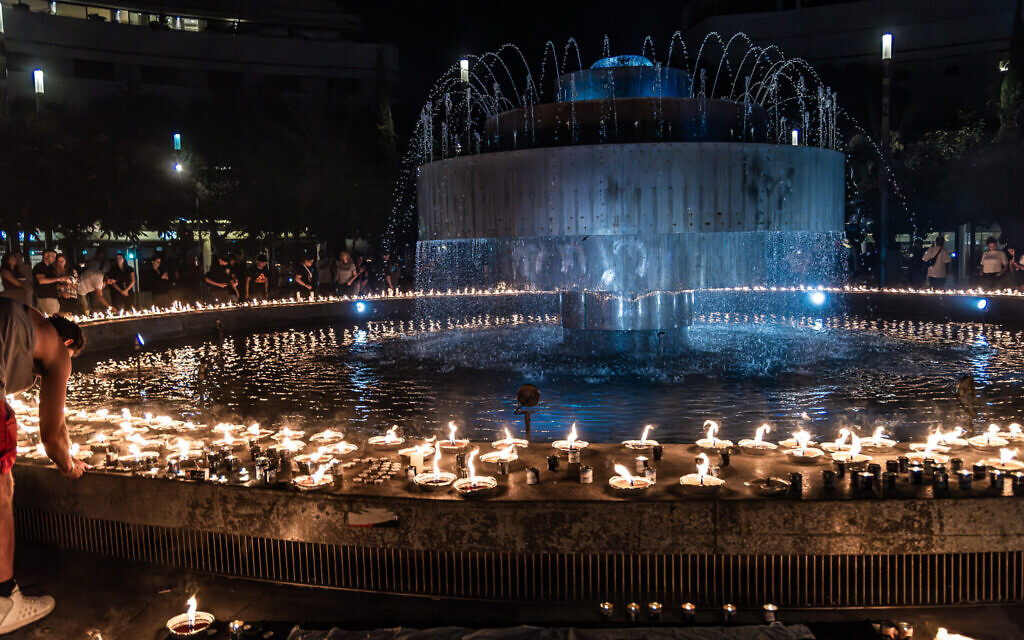


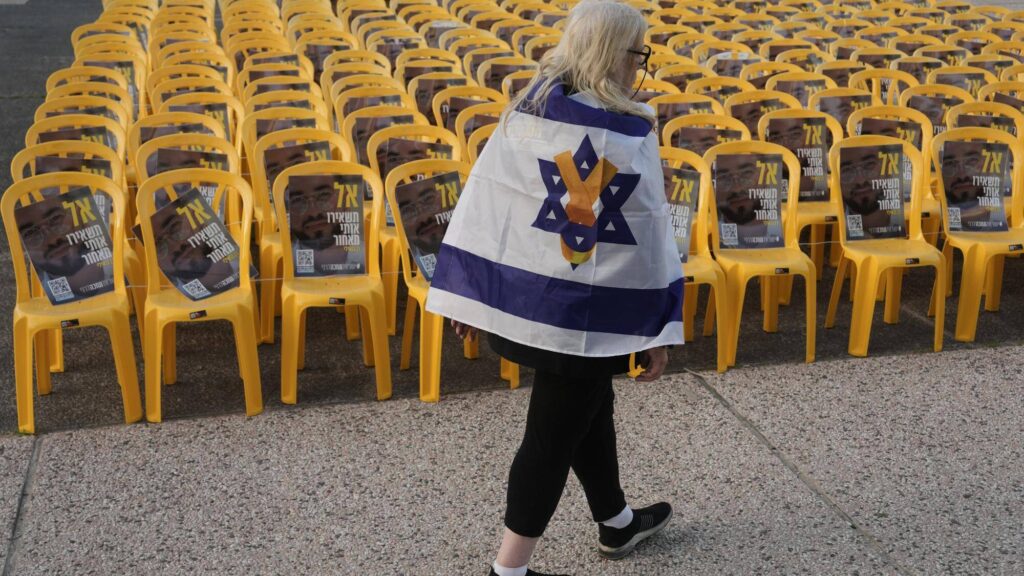
The photo of Ran Gvili, the last hostage, displayed on chairs in Hostages Square in Tel Aviv
For 843 days, Israeli society lived to the rhythm of October 7, which will remain the worst day since the country’s creation. For 843 days, the media daily recalled the tragic events of that day, the acts of heroism by civilians and soldiers who found themselves helpless in the face of the attack by several thousand Hamas members on their territory. For 843 days, tens of thousands of Israelis mobilized, week after week, in Hostages’ Square in Tel Aviv and throughout the country, repeating to the families: “You are not alone, we are with you!” More than a simple message of solidarity, this cry expressed a deep feeling of a shared destiny between the demonstrators and the hostages’ families. The entire country learned the names and stories of these 251 hostages, both living and dead. And the whole country celebrated their return as if it were that of a member of their own family.
It was this determined commitment of the population that made their return possible, right up to the very last one on January 26: the body of Ran Gvili, the police officer who, after saving around a hundred young people from the Nova festival, was killed while fighting to prevent dozens of Hamas members from entering Kibbutz Alumim. It was this mobilization that kept the fate of the hostages on the front pages of the Israeli media. It was also what pushed President Trump, as he publicly acknowledged, to force Netanyahu to accept a ceasefire, which was the condition for their release.
As for us, we obviously shared, with all Israelis, the joy of seeing the body of the last hostage returned to his family so that they could bury him. Will this final funeral finally allow Israeli society to heal its wounds and move on to another stage? Nothing is less certain. The wounds will take a long time to heal. More than twenty thousand civilians and soldiers were wounded during this war, and many of them will bear lifelong scars. As for the traumatized, they number in the hundreds of thousands, civilians and soldiers alike[1]. Just this week, another soldier took his own life on a military base, adding to an already too long list of suicides within the army over the past two years[2].
The reconstruction of destroyed homes in the kibbutzim and towns will take time; the rehabilitation of minds will take much longer.
The return of the last hostage has deprived the government of the pretext it had used until now to oppose moving to the second stage of Trump’s plan. This plan provides for the establishment of a technocratic government to oversee reconstruction and civilian life in Gaza under the authority of a Peace Council led by Trump himself. It also includes a partial withdrawal of the Israeli army in exchange for the disarmament of Hamas. This last point raises the most questions. Who will oversee this disarmament? Turkey, an ally of the Muslim Brotherhood, or Qatar, the financier of Hamas? Both will be part of the Peace Council, and Netanyahu will be forced to sit alongside them, despite all his denials, within this body he has joined. The very fact that the opening of the Rafah crossing between Gaza and Egypt was announced by Ali Shaath, head of the Palestinian technocratic government, is in itself significant: it shows that it will not be the Israelis who dictate what happens next, but rather the Americans.
Despite all Israeli statements, the fact that the bodies of all the hostages were found and returned is also proof that Hamas is still able to control the situation in the part of the Gaza Strip not occupied by the IDF. It also demonstrates the Palestinian organization’s determination to continue playing a role in the next phase.
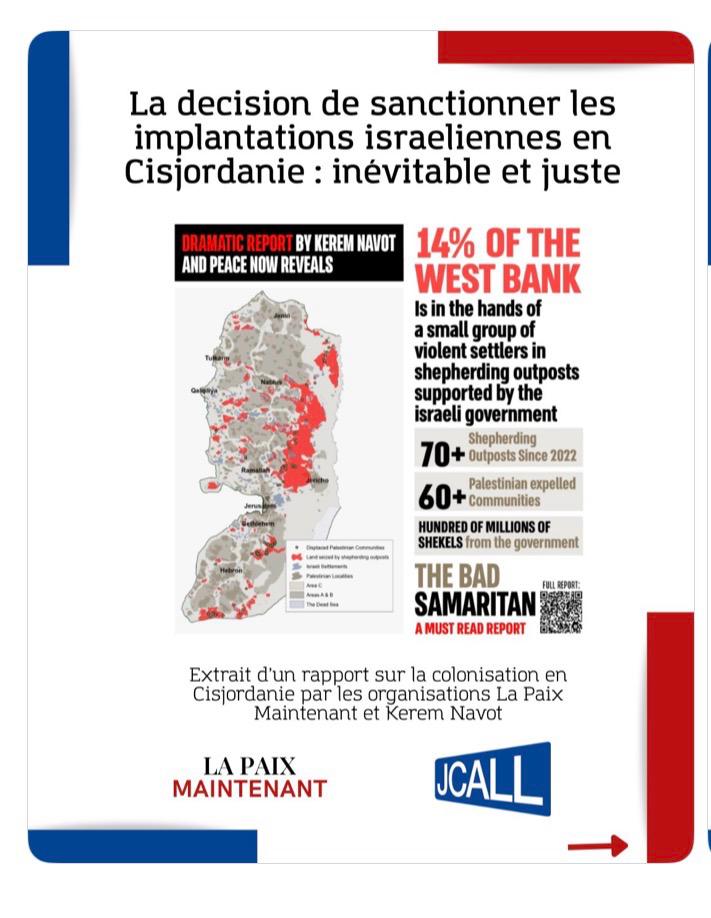
For two years, the Israeli government avoided preparing for “the day after,” and it is now forced to accept American decisions. These depend on the unpredictability of a president who can change his mind at any time. For now, his interest, and that of the United States, lies in implementing his plan. But what will happen when he realizes that his Riviera project in Gaza cannot be carried out at the expense of two million people who no longer have anywhere to return to? And if Trump succeeds in installing this Palestinian technocratic government in Gaza, will he be able to ignore the situation in the West Bank, where the Israeli government allows settlers to commit acts of violence against the Palestinian civilian population with impunity?[3] Will he go so far as to force the Israeli government, or the next one, to accept the emergence of a Palestinian state in order to secure Saudi and Emirati financial support?
Many questions remain unresolved. But one page has definitely been turned. The Israeli population is exhausted and, in its very large majority, aspires to an end to the war and to the return of reservists to civilian life. As for the Palestinian population, even if it cannot openly demonstrate against Hamas, it is awaiting salvation from international intervention.
This new phase must also allow the Israeli public to become aware of the scale of the humanitarian disaster in Gaza. Without calling into question the primary responsibility of Hamas leaders for this situation, the Israeli public will have to begin questioning the conduct of the war by its government and its army, and ask itself whether it might have been possible to bring it to an end earlier.
Many lessons must be drawn from this war in terms of security and organization. The IDF General Staff has probably already taken them into account. But what has not yet been done is a critique of the political approach that led to the catastrophe of October 7. This is what Netanyahu and his government, who bear primary responsibility, are trying to avoid by refusing to establish a national commission of inquiry. This demand, shared by the majority of the population, will undoubtedly be at the heart of the election campaign, along with the ongoing investigations showing collusion between the Prime Minister’s entourage and Qatar.
We thus return to the weight and role of civil society. It was its mobilization that made the return of the hostages possible. This victory over the government, for which the hostage issue was far from a priority, should inspire the opposition in Israel for the next election. It will only succeed in winning if it manages to maintain this popular mobilization. For our part, we will try, in the coming months, to make its voice heard.
David Chemla
[1] 600,000 requests for care were made to psychological care centers
[2] Since October 7, there have been 280 suicide attempts and 70 suicides among soldiers
[3] 1,485 violent abuses committed by settlers in the West Bank recorded in 2025, compared to 896 in 2024, 1,135 in 2023, 749 in 2022, 480 in 2021 and 348 in 2020